Selected from 835 applications across Africa, the innovations from Cameroon, Kenya, Nigeria, Egypt and Eswatini were presented at the 15th Africa Internet Governance Forum in Ghana, as the UN agency pushes for greater investment and support for homegrown AI solutions.
The United Nations Economic Commission for Africa (ECA) has showcased five African-led artificial intelligence innovations designed to address development challenges across agriculture, healthcare, energy, transportation and digital governance.
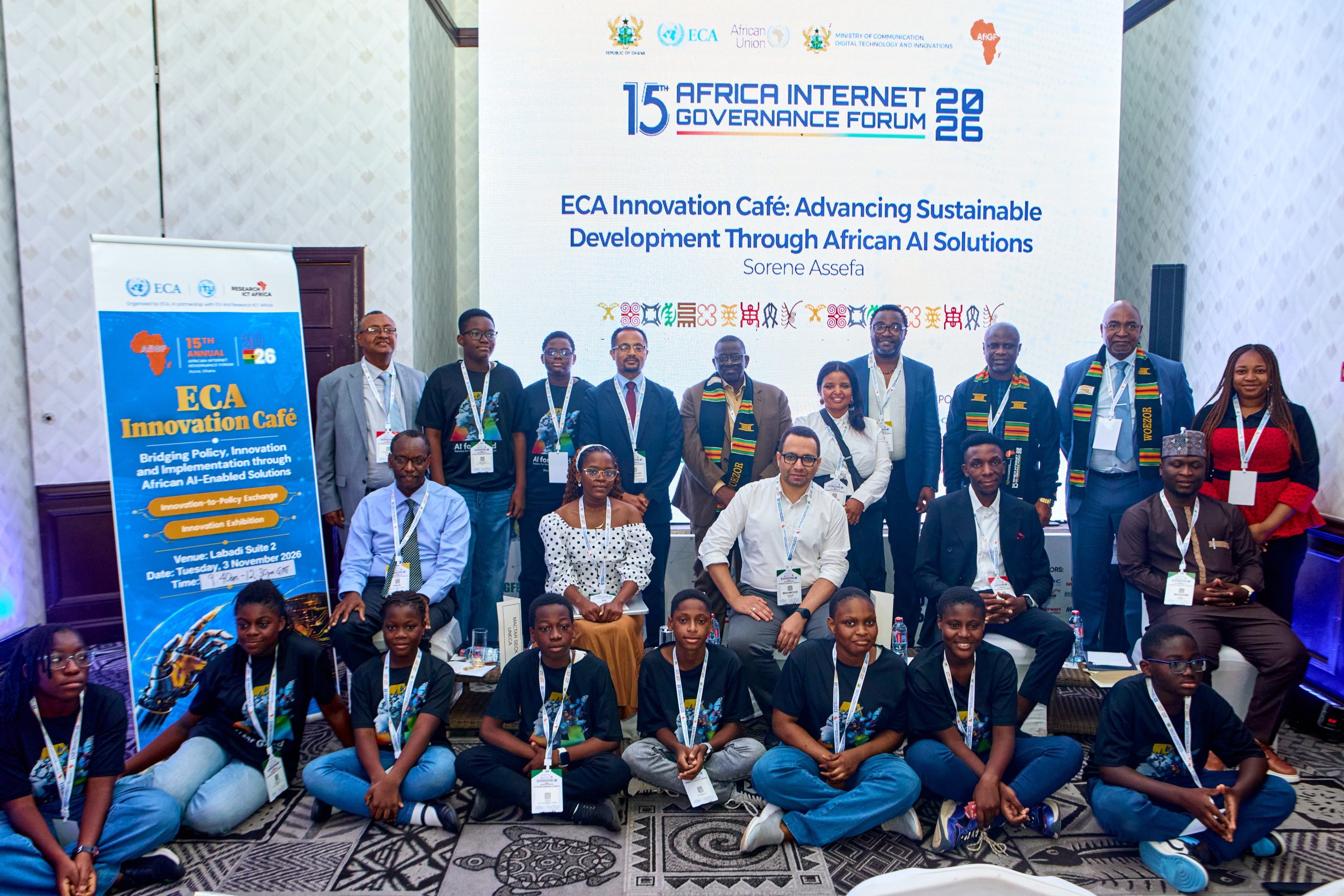
The innovations were presented on November 3, 2026, during the inaugural ECA Innovation Café at the 15th Africa Internet Governance Forum (AfIGF), held in Accra, Ghana.
Organised through the Africa IGF Secretariat in partnership with the International Telecommunication Union (ITU) and Research ICT Africa (RIA), the initiative was held under the theme, “Advancing Sustainable Development Through African AI Solutions.”
The five projects were selected from 835 applications received from across the continent. They were presented to a multidisciplinary panel of experts who assessed their technological potential, business models, development impact and opportunities for further growth.
The initiative aims to bridge the gap between African technological innovation, policymaking and implementation by creating opportunities for innovators to receive expert feedback, establish partnerships and identify pathways towards scaling their solutions.
Speaking at the event, Robert Lisinge, Director of ECA’s Technology, Innovation, Connectivity and Infrastructure Division, said the Innovation Café was designed to connect African innovation with sustainable development.
He emphasised that the initiative goes beyond showcasing technology by providing a platform to discuss policy requirements, investment opportunities and partnerships that can transform African ideas into practical development outcomes.
Five AI innovations addressing African development challenges
The five selected innovations represent different approaches to applying artificial intelligence to problems affecting African communities and industries.
1. AgricFresh – Cameroon
Presented by Afopezi Moses from Cameroon, AgricFresh is an AI-enabled agricultural market-linkage platform designed to help smallholder farmers reduce post-harvest losses and improve access to markets.
The platform combines artificial intelligence with solar-powered cold storage facilities to extend the shelf life of perishable agricultural produce.
It also connects farmers with potential buyers, helping improve market access and reduce the amount of food lost between harvesting and sale.
Agriculture remains a major source of employment and economic activity across Africa, yet farmers continue to face challenges involving inadequate storage, limited market information and inefficient distribution networks.
By combining AI-driven market connections with cold-storage infrastructure, AgricFresh seeks to address multiple stages of the agricultural supply chain.
2. AI Barabara – Kenya
Developed by Dr. John Mwangi Wandeto from Kenya, AI Barabara is an artificial intelligence-powered road assessment and infrastructure decision-support solution.
The platform uses road imagery to assess road conditions and provide information that can help authorities and infrastructure planners make decisions about road maintenance and rehabilitation.
It is also designed to support assessments of the economic feasibility of road projects, potentially helping governments prioritise infrastructure investments.
Across many African countries, poor road conditions, inadequate maintenance and limited infrastructure funding continue to affect transportation, trade and economic productivity.
AI Barabara seeks to use image-based analysis and data-driven decision-making to improve how road infrastructure is assessed and managed.
3. CoreHealth – Nigeria
Nigeria was represented at the Innovation Café through CoreHealth, an AI-powered healthcare management ecosystem presented by Ibrahim Akorede Jimoh.
The platform is designed to integrate different healthcare operations, including electronic medical records, clinical documentation, pharmacy management, laboratory services and other hospital workflows.
One of its notable features is AI-assisted clinical dictation and summarisation, which can help healthcare professionals document clinical information and manage patient records more efficiently.
The innovation addresses challenges associated with fragmented healthcare information systems, administrative workloads and the management of patient records.
Across Africa, many healthcare facilities still struggle with inadequate digital infrastructure and disconnected systems for managing medical information.
By bringing multiple healthcare operations into one digital ecosystem, CoreHealth aims to support more coordinated healthcare delivery and improve administrative efficiency.
Its selection also highlights the growing contribution of Nigerian innovators to the development of AI-powered solutions for critical sectors.
4. DevisionX – Egypt
Representing Egypt, Mahmoud AbdelAziz presented DevisionX, a sovereign AI platform designed to support secure artificial intelligence deployment in highly regulated sectors.
The platform combines computer vision, multimodal document intelligence and AI-powered workflow automation.
Its applications are targeted at government institutions, financial organisations, the justice sector and other institutions that require secure management and processing of sensitive information.
The concept of sovereign AI is increasingly important in discussions about Africa’s digital independence.
As governments and businesses adopt AI technologies, questions about where data is stored, who controls computing infrastructure and how sensitive information is processed are becoming increasingly significant.
DevisionX seeks to address some of these concerns by providing an AI platform designed for secure deployment in environments with strict regulatory and operational requirements.
5. SolarShare – Eswatini
The fifth innovation, SolarShare, was presented by Nolwazi Siphesihle Dlamini from Eswatini.
SolarShare is an AI-enabled community energy platform designed to monitor solar energy systems, identify available surplus electricity and match it with local energy demand.
The platform aims to support coordinated energy sharing and management within communities, potentially improving the utilisation of distributed renewable energy resources.
Its approach is particularly relevant to African communities where access to reliable electricity remains a challenge and decentralised solar energy systems are increasingly being explored as alternatives to conventional power infrastructure.
However, ECA noted that SolarShare is currently at the prototype stage. Live energy-data integration and physical energy-sharing arrangements are planned as subsequent development steps.
Experts identify challenges facing African AI innovators
Beyond presenting their technologies, the five innovators received technical, commercial and policy-focused feedback from a panel of experts with backgrounds in engineering, entrepreneurship, intelligent systems, innovation ecosystems and responsible AI governance.
The panel included Diana Kemunto Nyakundi, AI Fellow and Researcher at Research ICT Africa; Dr. Edwell Gumbo, Director of Entrepreneurship at Universities South Africa; Dr. Lebsework Negash of Addis Ababa University, Ethiopia; and Professor Paul Ndirangu Kioni of Dedan Kimathi University of Technology, Kenya.
A major issue raised during the discussions was the importance of high-quality and representative datasets in developing reliable AI systems.
Experts stressed that AI models must undergo rigorous testing and validation to ensure that their outputs are accurate, reliable and appropriate for the communities and environments in which they will be deployed.
They also highlighted the need for sustainable business models that reflect African market realities, including limited internet connectivity, high computing infrastructure costs, affordability challenges and varying regulatory requirements across countries.
Responsible AI development was another major focus.
The experts emphasised that data protection, cybersecurity, regulatory compliance and human oversight must be incorporated from the early stages of development, particularly for AI applications in sensitive sectors such as healthcare, finance, energy and public infrastructure.
They further called for inclusive AI solutions that remain accessible to underserved populations, including rural communities and people with limited access to digital devices, reliable internet connections and digital literacy programmes.
ECA pushes for stronger partnerships and investment in African AI
The Innovation Café forms part of broader efforts by ECA and its partners to strengthen Africa’s capacity to develop, adopt and scale locally relevant technologies.
While the continent has witnessed growing interest in artificial intelligence, many African innovators continue to face difficulties accessing funding, computing resources, technical expertise and institutional support required to move their solutions beyond the prototype stage.
By bringing innovators into direct engagement with policymakers, researchers, investors and technology experts, the initiative seeks to create stronger connections between innovation and the institutions capable of supporting its adoption.
Mactar Seck, ECA Chief of Emerging and Frontier Technologies, Innovation and Digital Transformation, who moderated the session, said the platform would allow innovators to refine their solutions, build partnerships and learn from one another.
He emphasised that the next step would be translating the feedback received into stronger and more scalable innovations capable of delivering tangible benefits across Africa.
What this means for Africa’s AI ecosystem
The five innovations demonstrate how African developers are exploring practical applications of artificial intelligence beyond general-purpose chatbots and productivity tools.
From reducing agricultural losses in Cameroon to improving road infrastructure assessments in Kenya, supporting healthcare management in Nigeria, strengthening digital sovereignty in Egypt and improving community energy management in Eswatini, the projects illustrate the potential of AI to address development challenges across different sectors.
However, showcasing these innovations is only the beginning.
Their long-term impact will depend on access to investment, supportive government policies, reliable digital infrastructure, quality datasets and partnerships that enable them to move from prototypes and early-stage solutions to widespread deployment.
For African governments, the initiative also raises an important question: how can national AI strategies translate into practical support for local innovators rather than focusing primarily on technology adoption?
As Africa continues to develop its AI ecosystem, initiatives such as the ECA Innovation Café could provide an important link between homegrown technological ideas, policy development and investment.
The broader objective is to ensure that Africa does not remain only a consumer of artificial intelligence technologies developed elsewhere, but also becomes a stronger contributor to the development of solutions addressing its own economic and social challenges.