
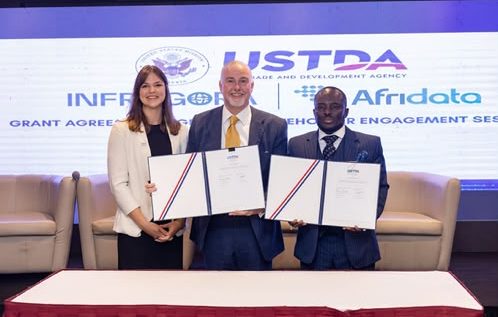
The proposed facilities in Lagos and Delta States could deliver 60-70 megawatts of data centre capacity, with the potential to expand to 100 megawatts, as Nigeria seeks to strengthen its position in Africa’s digital economy.
The United States Trade and Development Agency (USTDA) has signed an agreement with African investment firm INFRAGORA Global Capital to fund a feasibility study for the development of two large-scale data centres in Nigeria.
The agreement, which was celebrated by the US Mission in Nigeria in an October 29 social media post, represents another step towards addressing Africa’s limited digital infrastructure capacity and strengthening Nigeria’s readiness for artificial intelligence (AI), cloud computing and other data-intensive technologies.
In its announcement, the US Mission highlighted that Africa accounts for less than two per cent of the world’s data centre capacity, arguing that Nigeria could play an important role in changing the situation.
According to USTDA, the proposed facilities will be located in Lagos and Delta States and form the initial phase of INFRAGORA’s wider AFRIDATA Datacenter Platform, a planned continental initiative aimed at expanding digital infrastructure across Africa.
$1.87 Million Grant to Support Feasibility Study
USTDA is providing a $1.87 million grant to support the feasibility study, which will examine the technical and financial requirements for establishing the two facilities.
The proposed data centres are expected to have a combined initial capacity of between 60 and 70 megawatts, with provisions for expansion to a total capacity of 100 megawatts.
Under the proposed arrangement, Lagos State will host the primary facility, designed to support artificial intelligence workloads and cloud computing services. The facility is expected to meet Tier IV certification standards, which represent a high level of infrastructure reliability and resilience.
The second facility, planned for Delta State, will provide backup infrastructure and disaster recovery services, helping maintain operations in the event of disruptions at the primary location.
USTDA’s project documentation indicates that the feasibility study will also assess the commercial viability of the facilities, identify suitable technology providers, evaluate regulatory requirements and determine what financing would be needed to move the project towards implementation.
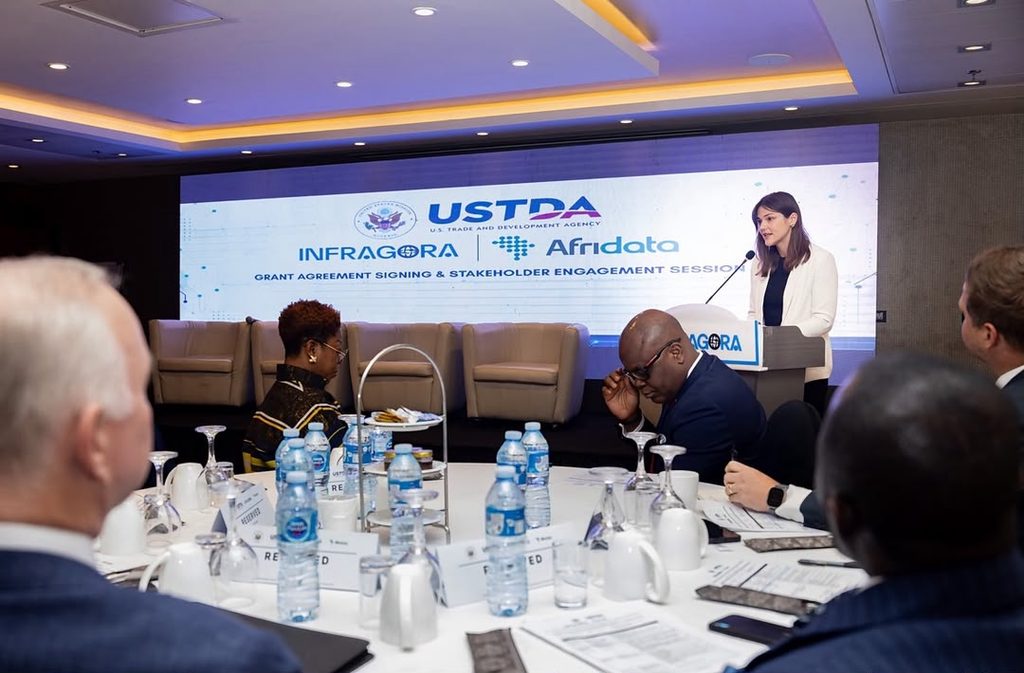
Strengthening Nigeria’s AI and Cloud Computing Infrastructure
The proposed investment comes at a time when demand for computing power, cloud storage and data processing infrastructure is increasing across the world.
Artificial intelligence systems, particularly those involving large language models, machine learning and advanced computing, require substantial processing capacity and reliable infrastructure to operate effectively.
However, Africa’s limited data centre capacity means that businesses, technology companies and other institutions often depend on infrastructure hosted outside the continent.
This dependence can create challenges involving connectivity, service costs, latency, data security and the ability of African countries to develop and scale their own AI technologies.
The proposed AFRIDATA facilities are expected to provide infrastructure for cloud service providers, financial institutions, telecommunications companies, technology startups and government agencies.
USTDA has also indicated that the project could create opportunities for American companies supplying AI software, cloud infrastructure, data storage systems, networking equipment, advanced computing hardware and cybersecurity solutions.
Part of a Wider African Infrastructure Initiative
The Nigerian project is the first phase of INFRAGORA’s planned AFRIDATA Datacenter Platform, which aims to establish data centre infrastructure across multiple African markets.
The company has identified other potential markets, including Angola, Cameroon, Côte d’Ivoire, Egypt, Ghana, Kenya and South Africa.
According to USTDA, the Nigerian feasibility study is intended to help establish the foundation for the wider continental initiative.
INFRAGORA has described the platform as an effort to bring together AI-ready data centres, cloud infrastructure, reliable power, technology innovation and local capacity development to support Africa’s digital economy.

What This Means for Nigeria
If successfully implemented, the proposed facilities could strengthen Nigeria’s capacity to host digital services locally, support AI development and attract further investment into its technology sector.
The project could also create opportunities in construction, engineering, data centre operations, cybersecurity and other specialised technology services.
However, the agreement is currently focused on funding a feasibility study. It does not mean that construction of the two data centres has commenced or that the proposed investment has been fully secured.
The project’s eventual implementation will depend on the findings of the study, financing arrangements, regulatory approvals, power availability and other technical requirements.
Reliable electricity supply will be particularly important, given the substantial energy requirements of large-scale data centres and AI computing infrastructure.
For Nigeria, the initiative presents an opportunity to strengthen its position in Africa’s emerging AI infrastructure market. But turning that opportunity into reality will require more than investment announcements. It will depend on the country’s ability to provide reliable power, competitive operating conditions, strong connectivity and the technical expertise needed to sustain these facilities.
As artificial intelligence becomes increasingly important to economic growth and technological competitiveness, investments in the infrastructure that powers AI could prove just as important as the development of AI applications themselves.


