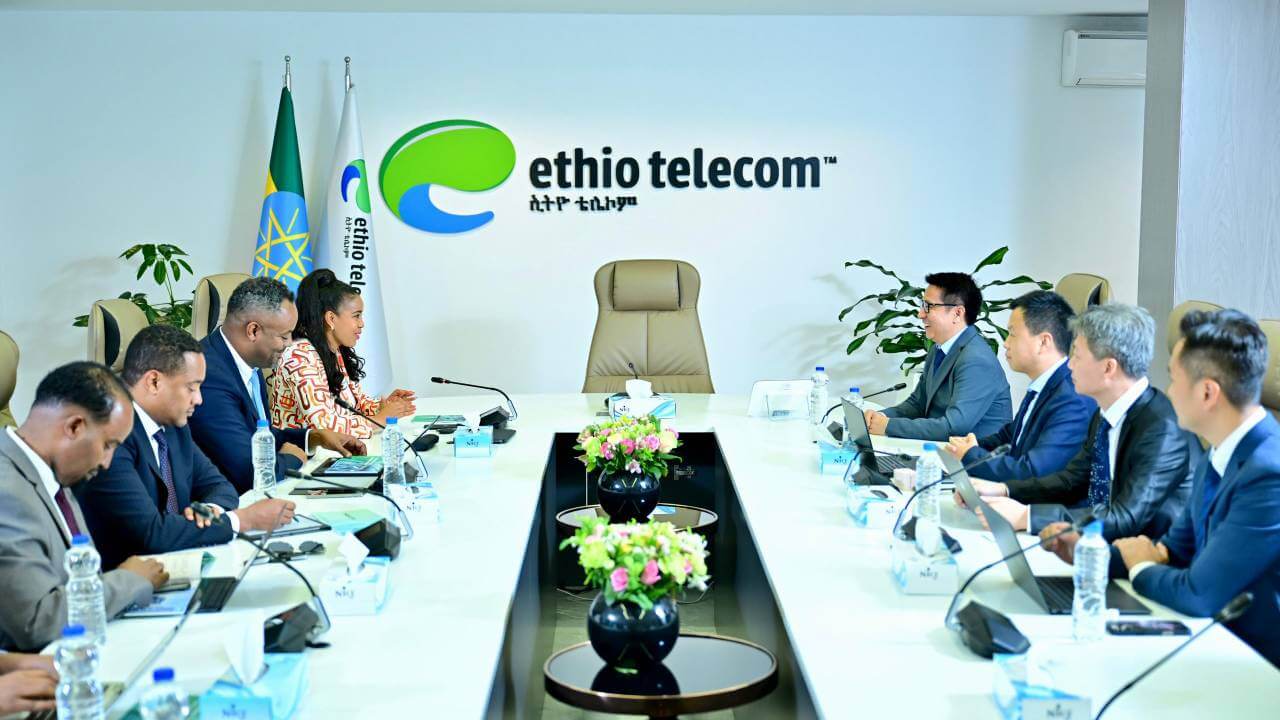
Ethio telecom and ZTE say AI beam scheduling lifted 4G capacity by 11 percent and peak-hour speeds by 40 percent, as Addis Ababa chases a place among Africa’s leading AI hubs by 2030.
By AI Reports Africa | 12 November 2026
ADDIS ABABA, Ethiopia. Ethiopia’s state-owned operator has put artificial intelligence inside its mobile network for the first time. Ethio telecom and Chinese equipment maker ZTE announced on 4 November that they have deployed the country’s first pre-commercial AI Radio Access Network, known as AIR RAN, a system designed to wring more performance out of the 4G infrastructure already standing across the country.
The companies report an 11 percent increase in 4G capacity and a 40 percent improvement in user throughput during peak hours. If those numbers hold at scale, they would matter for an operator serving more than 90 million subscribers, many of them crowded onto networks that strain at the busiest hours of the day.
What was actually deployed
The radio access network is the part of a mobile network that connects phones to the operator’s core. AIR RAN builds on Frequency Division Duplex Massive MIMO, an antenna technology that lets a single site serve many users at once, and adds ZTE’s AIREngine computing engine on top.
The AI element is beam scheduling. Instead of spreading radio resources evenly, the system steers capacity toward the areas where demand is spiking at that moment and shifts it as traffic patterns move. In practical terms, the network learns where people are and what they are doing, then adapts, rather than waiting for engineers to add equipment.
The companies say they worked on the system for roughly two years, and that it supports Ethio telecom’s Next Horizon: Digital & Beyond 2028 strategy, which aims to turn the operator into an AI-native digital company rather than a pure connectivity provider. That plan targets 100 million subscribers by the end of the 2027/28 financial year.
The numbers, and what they leave out
The headline figures deserve careful reading. According to reporting by CIO Africa, the gains are measured against what the companies describe as a traditional network solution, and neither company has offered independent verification.
Important details have also not been made public. The announcement did not say which city or how many sites were involved, what the baseline speeds were, or how long the trial ran. Nor did it give a date for commercial rollout, or say how much it would cost to scale the technology across the national network. Neither announcement carried a direct comment from an Ethio telecom or ZTE executive on the expected commercial impact.
For a pre-commercial deployment, that is not unusual. But it means the 40 percent figure is best treated as a promising claim from the vendor and the operator, not yet a measured national result.
Why efficiency matters so much here
Ethio telecom is under pressure to deliver capacity quickly, and software may be the faster route. Figures reported by Addis Fortune in July, and relayed by CIO Africa, show the operator installed 603 of the 1,228 mobile sites planned for the 2025/26 financial year, about 49 percent of target. Mobile data users reached 51.53 million against a goal of 56.63 million. Equipment arrived mostly in May and June, held up by the Red Sea shipping crisis and fuel shortages.
Separately, a network modernisation programme with ZTE had completed work at 879 sites by October, including 462 RAN modernisation sites, and has helped push 4G population coverage above 92 percent within ZTE’s footprint, according to Tech Africa News and TelecomTV.
In that context, AIR RAN offers a different kind of lever. If software can extract more capacity from towers already built, the operator gains breathing room while physical expansion catches up. It does not replace new sites, but it can make each existing one work harder.
The bigger national ambition
The deployment lands inside a much larger story. Ethiopia’s Digital Ethiopia 2030 strategy, launched in December 2025 in the presence of Prime Minister Abiy Ahmed, sets out goals that include 128 million mobile subscribers and full 5G coverage by 2030, alongside an expanded AI ecosystem. Ecofin Agency reports that the government aims to position Ethiopia among Africa’s leading AI hubs by that date.
In February 2026, Deputy Prime Minister Temesgen Tiruneh inaugurated the AI University Innovation Pod in Addis Ababa, a facility developed with the Ethiopian Artificial Intelligence Institute, Addis Ababa University and UNDP’s timbuktoo initiative. He described it as a shift from technology consumer to technology creator.
A smarter network and a national AI hub are different things, but they depend on each other. Talent, startups and AI services need reliable, affordable connectivity to reach users. Operators that run intelligent networks gain operational skills and data that feed back into the wider ecosystem.
A sobering baseline
The distance still to travel is significant. Addis Fortune, citing the World Bank’s Digital Progress and Trends Report, noted in August that Ethiopia sits in the lowest quartile globally for AI readiness, pointing to infrastructure gaps and limited adoption. A pre-commercial pilot, however well it performs, does not close that gap on its own.
There is also a question of dependence. Ethio telecom’s AI-enabled network runs on a single vendor’s engine, in a country where Chinese suppliers, ZTE and Huawei among them, have long underpinned the telecom build-out, including the pre-commercial 5G launch in Addis Ababa in 2022. Whether Ethiopia builds local skills around such systems, or simply operates them, will shape how far the benefits travel.
What to watch next
Three things will determine whether this milestone becomes a turning point. First, whether Ethio telecom publishes verified results, including sites, locations, duration and baselines. Second, whether a commercial rollout date and investment figure follow. Third, whether the efficiency gains help the operator close its site-deployment gap and reach its subscriber targets.
For now, Ethiopia has crossed a symbolic line: AI is no longer only a policy aspiration in Addis Ababa, it is running inside the network that carries the country’s calls and data. The harder work, proving it at scale and turning it into broader digital capability, begins now.
Sources: ZTE and Ethio telecom announcement (4 November 2026) as reported by Mobile World Live, iAfrica.com and Developing Telecoms; CIO Africa (7 November 2026); Capital Ethiopia (6 November 2026); Tech Africa News; TelecomTV; Addis Fortune; Ecofin Agency; UNDP Ethiopia; ENA.