The pan-African carrier’s biggest funding round yet will pay for data centres, open-access fibre and new subsea cable capacity. Washington then added a $155 million stake of its own, raising questions about who will own the infrastructure that AI runs on.
ABUJA – Artificial intelligence needs fast networks and plentiful computing capacity long before it needs clever models. On much of the African continent, both remain scarce. A $300 million investment in one of the continent’s largest wholesale digital infrastructure companies is an attempt to close part of that gap, and it comes with a notable cast of investors.
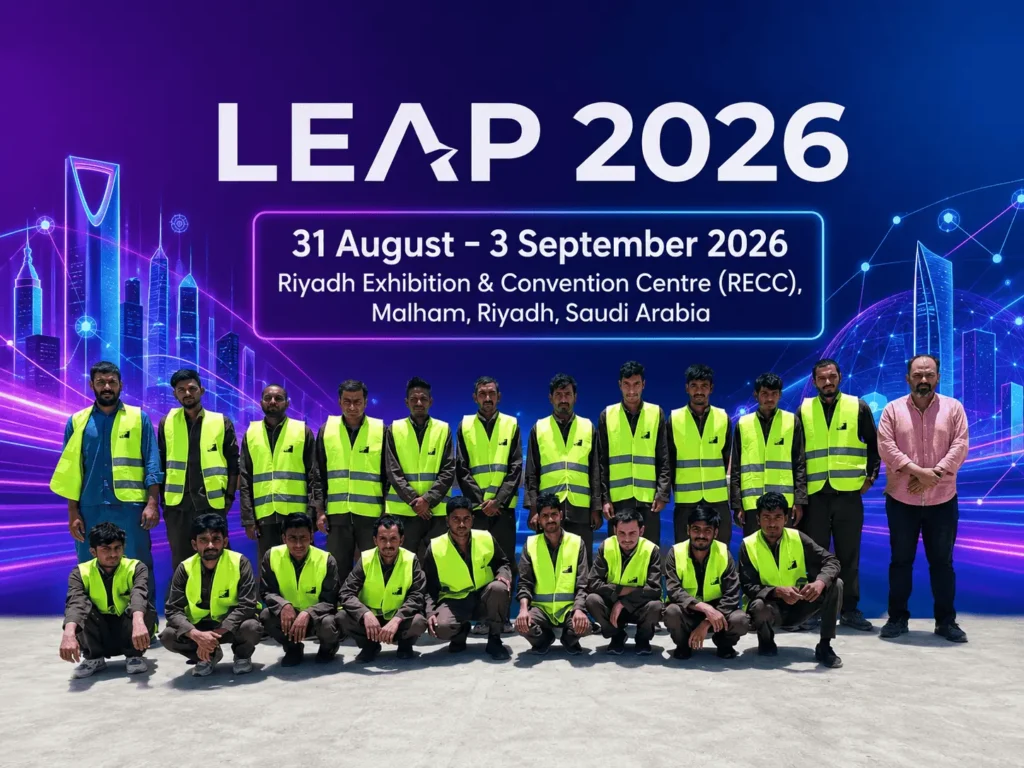
WIOCC Group signed a shareholder subscription agreement on September 1 with the Africa Finance Corporation (AFC) and Saudi Arabia’s Vision International Investment Company, known as Vision Invest, for a combined $300 million. The deal was signed at the LEAP 2026 technology exhibition in Riyadh. WIOCC says the money will fund data centre deployment and consolidation, expansion of its open-access terrestrial fibre footprint, and investment in new subsea cable assets.
By the measure of WIOCC’s own history, it is a large cheque. TechCentral described it as by some distance the largest capital raise in the company’s history, noting that it exceeds the whole of WIOCC’s $200 million round in 2022 and amounts to roughly three-quarters of the more than $400 million the group raised across three rounds in 2025.
What WIOCC is
WIOCC describes itself as Africa’s leading carrier-neutral digital infrastructure platform. Its portfolio spans subsea cable capacity, terrestrial and metro fibre networks, hyperscale data centres and digital platforms, and it operates in more than 30 African countries, according to the US government agency that has since invested in it. One regional outlet counts more than 40 core and edge data centres across the footprint.
Much of that data centre estate sits in Open Access Data Centres (OADC), a WIOCC subsidiary. DCD reports that OADC has six hyperscale data centres and more than 30 edge sites across South Africa, the Democratic Republic of Congo and Nigeria. In South Africa, OADC completed the purchase of seven NTT Data facilities on December 31, 2025, adding more than 25 megawatts and sites in Bloemfontein, Cape Town, East London, Gqeberha, Durban and Johannesburg, TechCentral reports.
WIOCC’s shareholders include African telecom operators such as Telkom Kenya, Uganda Telecom, Djibouti Telecom, Zantel, Botswana Fibre Networks and TelOne, alongside the International Finance Corporation (IFC) and African Capital Alliance.
Who is writing the cheque
The Africa Finance Corporation is a multilateral development financier established in 2007 by African states. It says it has invested more than $19 billion across 36 African countries. Vision Invest is a Saudi infrastructure investor, formerly known as ACWA Holding, whose portfolio has centred on power generation, water desalination and logistics. Its first direct African investment came in September 2025, when it took a stake in the industrial park developer Arise IIP, a company in which the AFC was already a shareholder.
Neither investor’s role has been itemised. The announcement disclosed no valuation, no equity stake, no split of the $300 million between the two investors, and no detail on how the new money dilutes existing shareholders, TechCentral noted.
Chris Wood, WIOCC’s group chief executive, framed the raise around demand, saying Africa is “uniquely positioned to capitalise on the next phase of global digital growth.” The company has given no project-by-project breakdown.
Why the money matters for AI
The gap the investment targets is large. The International Telecommunication Union (ITU) estimates that only 35.7 percent of Africans were online in 2025, against a global average of 73.6 percent. A research funding call published in August by the Science Granting Councils Initiative put the continent’s share of global data centre capacity below 1 percent, despite its 18 percent share of the world’s population.
AI raises the stakes. Training large models is concentrated in a handful of countries, but running them for local users depends on nearby compute and low-latency connections. That is where data centres and fibre become strategic assets. PwC’s Global Data Centre Outlook 2026–50 projects cumulative African data centre investment of $255 billion by 2050 in its central scenario.
WIOCC is also entering a market that is already crowded and expensive. In South Africa, Teraco, owned by Digital Realty, has close to 190 megawatts of IT load and about $877 million of committed investment, TechCentral reports. Vantage Data Centers is building a $1 billion campus near Midrand, and the Cavaleros Group has announced campuses of 360 megawatts in Cape Town and 200 megawatts north of Johannesburg. WIOCC’s own strategy chief, Joshua Smythwood, has said the market is “entering a phase of consolidation.” The company listed consolidation first among its uses for the new funds, which suggests acquisitions are on the agenda.
Washington joins the cap table
A fortnight after the Riyadh signing, a third source of capital emerged. On September 16, the US International Development Finance Corporation (DFC) said it would invest up to $155 million in WIOCC, its largest-ever equity investment, alongside Vision Invest and the AFC.
The DFC was explicit about its motives. Its chief executive, Ben Black, said the agency was committed to “winning the AI race for America,” and described WIOCC as a preferred partner for US technology companies expanding in Africa. Reuters reported that Washington has increasingly backed digital infrastructure in Africa as an alternative to Chinese suppliers such as Huawei, including a $100 million loan to the US-owned operator Africell. A DFC summary reported by a smaller outlet says WIOCC aims to grow its fibre subscribers 100-fold by 2031.
How the DFC’s $155 million relates to the $300 million is not clear from public statements. The DFC said it would invest alongside Vision Invest and the AFC, which suggests the two are connected, but a report citing DFC documents also described the US stake as part of a project costing up to $450 million, and noted that it is not public how the funds will be divided across projects.
The questions that follow
The investment is good news for connectivity, but it raises questions that matter to African governments and regulators:
- Neutrality. WIOCC sells itself as carrier-neutral and open-access. Washington is describing its stake in terms of “trusted networks” and countering Chinese providers. Customers and regulators will want to know how that framing affects who can buy capacity and on what terms.
- Control and sovereignty. With development banks, a Gulf investor and a US agency on the register, how much influence African telecom operators retain as shareholders is an open question. The disclosed terms do not say.
- Access beyond the hubs. Data centres tend to cluster where power and customers already exist. Whether the new capital reaches under-served markets will depend on where WIOCC deploys it, which has not been specified.
- Power and cost. Data centres are energy-hungry, and South African operators have already faced pressure on electricity supply and prices. Capacity built without secure, affordable power will not deliver cheaper AI.
What to watch
Readers should look for WIOCC’s first announced projects, any further data centre acquisitions, new subsea cable commitments and the terms of the DFC’s involvement. For a continent where AI adoption is limited as much by infrastructure as by skills, the real test is whether the money lowers the cost and raises the quality of connectivity for businesses and ordinary users outside the main hubs.
Sources and verification notes
- WIOCC press release (September 1, 2026), via SubTel Forum, and reporting by TechCentral (September 1), DCD, The Tech Capital, Techweez and Submarine Networks.
- Reuters (September 16, 2026) and TechCentral (September 17) on the US DFC investment; furtherafrica.com and Rio Times for additional detail.
- ITU data on Internet use, as cited by Techweez; ICTworks (August 3, 2026) on Africa’s share of global data centre capacity; IT-Online (September 29, 2026) on PwC’s outlook.
Editor’s checks before publication:
- Confirm with WIOCC whether the DFC’s $155 million is part of, or additional to, the $300 million. Public statements do not settle it. The “$450 million project” figure comes from a minor outlet citing DFC documents and should be verified against the DFC’s own disclosure.
- One outlet describes WIOCC as Kenya-headquartered. Reuters and the DFC say Johannesburg. The article follows Reuters.
- The “preferred partner” and “100 times by 2031” claims are DFC statements reported second-hand. Check them against the DFC summary.
- The deal was signed a month ago, so some trade outlets are running it as fresh news. Date it accordingly.
- Ask WIOCC for the split between AFC and Vision Invest, the equity stakes, and the first planned projects.