The White House has formally instructed U.S. agencies to use “Super Intelligence” or “SI” instead of “Artificial Intelligence” or “AI”. Behind the language change is a much bigger contest over compute, energy, data, regulation and technological power and Africa cannot afford to watch from the sidelines.
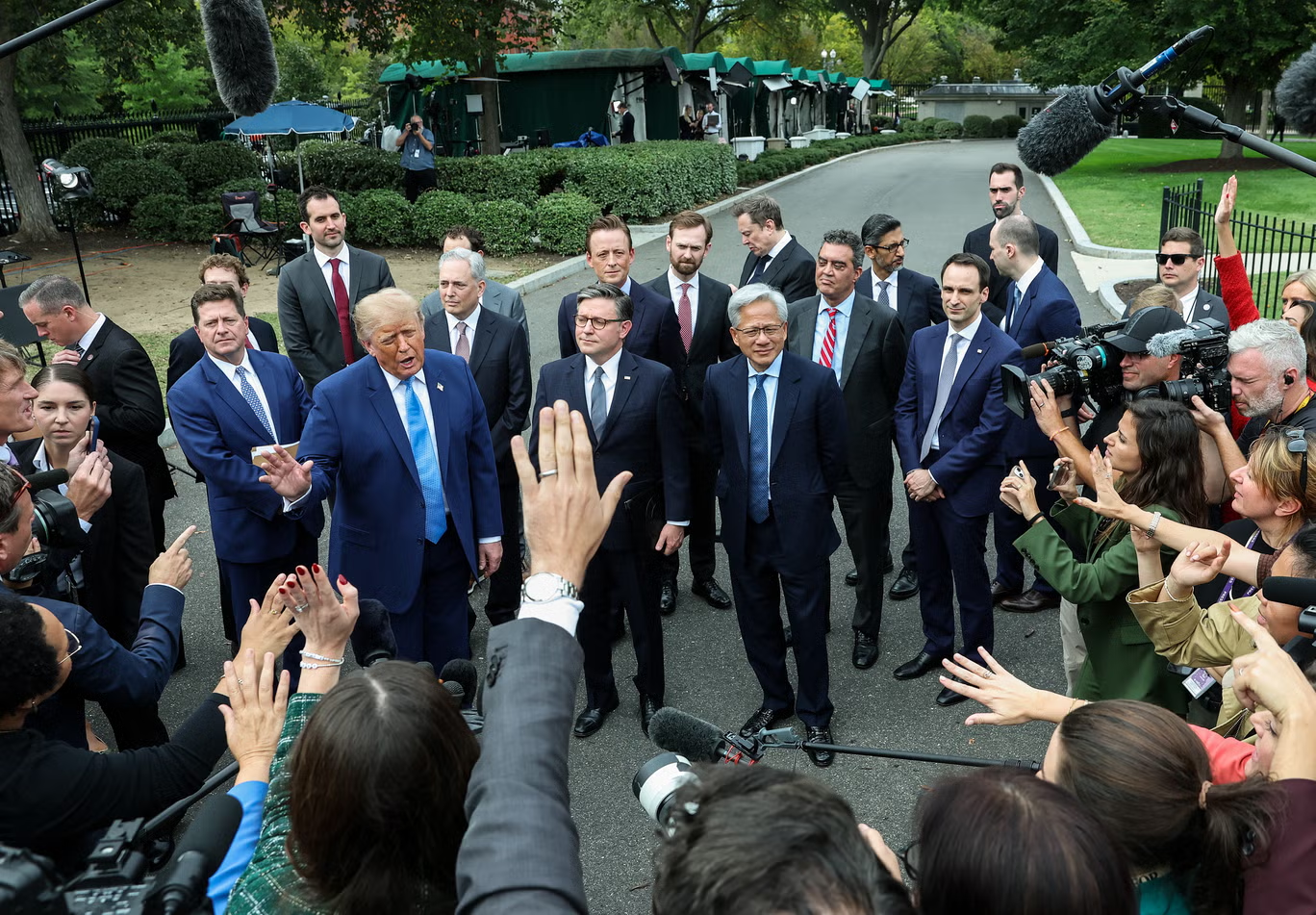
When U.S. President Donald Trump sat alongside some of the world’s most powerful technology executives at the White House on Tuesday, September 29, the meeting produced more than another discussion about artificial intelligence.
It produced a new vocabulary.
Trump announced that the technology would now be referred to as “Super Intelligence” (SI), and later signed an executive order directing U.S. federal agencies to use “Super Intelligence” and “SI” in official correspondence, public communications, websites, reports, policy documents and other non-statutory materials, where legally permitted. (Fox Business)
But this does not mean that the world has suddenly agreed that AI has become a new technology called SI.
Rather, the United States government has adopted a new term for the technologies it has previously described as artificial intelligence. The terminology is significant because it reflects how Washington is framing the next stage of the technology race.
And that is where Africa needs to pay attention.
Beyond the name: a battle over technological infrastructure
The White House announcement came alongside a meeting involving senior figures from companies including OpenAI, Anthropic, Google, Meta, Nvidia and xAI.
The companies also signed what Trump described as a voluntary agreement to strengthen internal safeguards around advanced AI systems. The accord includes commitments around independent assessment, internal controls and preventing AI systems from accessing or manipulating technical systems in unintended ways. Trump described the agreement as “morally binding”, rather than a conventional legally enforceable regulation. (Reuters)
The meeting therefore combined three issues that will increasingly define the global technology race:
computing power, energy and governance.
For Africa, these three issues are more important than whether the technology is called AI or SI.
The continent is already behind in the infrastructure required to build and deploy advanced AI systems. The International Monetary Fund estimates that Africa hosts only about 160 data centres, representing approximately 5.5% of global installations, with much of the continent’s infrastructure concentrated in South Africa, Nigeria and Kenya. (IMF eLibrary)
This creates a fundamental question:
If the world is entering a “Super Intelligence” era, who will own the infrastructure on which African intelligence runs?
Africa’s biggest problem may not be AI: it may be compute
The global AI race is increasingly becoming a race for access to GPUs, data centres, cloud infrastructure and electricity.
The IMF’s 2026 analysis points to a rapidly expanding African AI infrastructure market. Among the developments it identifies are Microsoft’s planned $1 billion, 100-megawatt green data centre campus in Kenya and a $700 million partnership involving Cassava Technologies and Nvidia to deploy 12,000 GPUs across South Africa, Nigeria, Kenya, Egypt and Morocco. (IMF eLibrary)
Nigeria is also positioning itself for this emerging infrastructure economy.
In September 2026, the U.S. Trade and Development Agency announced funding for a feasibility study supporting two proposed AI-ready data centres in Lagos and Delta states. The agency described the project as part of efforts to strengthen Nigeria’s digital economy and expand trusted technology infrastructure. (USTDA)
Nigeria’s own government has also unveiled a National Digital Cloud Policy designed to attract investment into cloud and data-centre infrastructure, expand domestic computing capacity and position the country as a regional digital-services and hosting hub. The policy explicitly identifies AI compute capacity and digital sovereignty as priorities. (Federal Ministry of Communications)
These developments suggest that Africa is not absent from the infrastructure race.
But participation is different from ownership.
The electricity question
There is another uncomfortable reality.
There is no AI without energy.
The International Energy Agency says affordable, reliable and sustainable electricity will be a crucial determinant of AI development. A typical AI-focused data centre can consume as much electricity as roughly 100,000 households, while the largest facilities under construction can consume many times more. (IEA)
This creates a particularly important challenge for Africa.
The IMF estimates that around half of the population of sub-Saharan Africa lacks reliable electricity, while only about 38% of Africans used the internet in 2024, compared with 68% globally. (Reuters)
The contradiction is obvious.
Africa is being told that the next economic revolution will be powered by increasingly sophisticated computing systems, while millions of Africans still struggle to obtain the electricity and connectivity required to participate in the digital economy.
The rise of SI could therefore produce two very different Africas.
One could become a regional destination for data centres, cloud infrastructure, AI research and digital services.
The other could remain primarily a consumer of foreign AI products.
The difference will depend heavily on infrastructure investment and policy decisions made now.
Data sovereignty becomes even more important
The shift from AI toward increasingly powerful systems also raises a question that African policymakers have been discussing for years:
Where does African data live, who controls it and who benefits from it?
Africa’s data is valuable.
Health records, financial transactions, agricultural information, government records, education data, consumer behaviour and African-language content can all contribute to the development and deployment of AI systems.
But if African data is processed predominantly on infrastructure controlled elsewhere, the continent may capture only part of the economic value generated from its own information.
This is why the African Union’s Continental Artificial Intelligence Strategy describes AI as a strategic asset for Africa and calls for African countries to strengthen domestic AI capacity, research, infrastructure and homegrown solutions. (African Union)
In May 2025, an AU high-level policy dialogue went further, calling for African countries to develop the digital infrastructure, high-quality datasets, computing capabilities, skills and research capacity necessary for responsible AI development. It also emphasized protecting African interests, privacy and personal data. (African Union)
The conversation is therefore moving from simply asking:
“How can Africa use AI?”
to a more consequential question:
“How can Africa own enough of the AI value chain to determine its own future?”
The language problem is also an African opportunity
There is another dimension of the SI conversation that could easily be overlooked: language.
Africa is home to thousands of languages, but many remain severely underrepresented in digital datasets and AI systems.
That creates both a technological disadvantage and an opportunity.
In April 2026, the GSMA and Pleias launched CommonLingua, an open-source language-identification model covering 334 languages, including 61 African languages. Researchers have also been developing benchmarks specifically designed around African languages and cultural contexts. (GSMA)
This matters because increasingly capable AI systems will only be as useful to African communities as the data and languages they understand.
A system that performs exceptionally well in English but poorly in Hausa, Yoruba, Igbo, Amharic, Kiswahili, Wolof, Zulu or thousands of other African languages cannot fully serve the continent.
The SI era could therefore create a market for something Africa has historically undervalued:
African data infrastructure.
Building high-quality datasets, language resources, evaluation benchmarks and culturally relevant AI systems could become strategically important infrastructure — just like fibre-optic cables and data centres.
The jobs question: Africa needs to move beyond “AI will create jobs”
Much of the African AI conversation has focused on whether artificial intelligence will create or destroy jobs.
The more immediate question may be whether Africans will occupy the high-value jobs created by the new technology.
Advanced AI will require:
- AI researchers and engineers
- data scientists
- cybersecurity specialists
- chip and hardware engineers
- cloud and infrastructure professionals
- AI safety researchers
- policy and governance experts
- domain specialists in healthcare, agriculture, finance and education
- African-language data specialists
- journalists and investigators capable of auditing AI systems.
Africa has a young population and a large pool of technology talent.
But talent without infrastructure, capital and access to advanced computing can easily become an export commodity.
African engineers can build products for companies headquartered elsewhere while the highest-value intellectual property, infrastructure and revenues remain outside the continent.
That is why the current infrastructure race matters as much as the AI race.
There is already an African response
Africa is not starting from zero.
The African Union has established a continental AI strategy. East African governments have also begun discussing AI sovereignty more explicitly.
In April 2026, the East African Community announced plans for a regional AI technologies fund and called for AI systems that speak regional languages, are trained on East African data, are hosted on regional infrastructure and are governed by East Africans. (East African Community)
The United Nations Development Programme has meanwhile documented AI-compute deployments in Kenya, Malawi, Rwanda, South Africa, Togo and Zambia.
Its 2026 study makes an important point: simply installing computing infrastructure is not enough. Countries also need usable data, skilled operators, institutional ownership, governance, cybersecurity, sustainable financing and clear public-interest applications. (UNDP)
That lesson may be one of the most important for Africa.
A data centre is infrastructure.
It is not an AI ecosystem.
What should African governments be watching now?
The Trump administration’s decision to popularize “Super Intelligence” should not lead African governments into a race to simply adopt the newest terminology.
Instead, it should force a harder examination of five strategic questions.
1. Who owns the compute?
African countries need to know how much advanced computing capacity exists locally, who owns it, who can access it and whether African researchers and startups can afford to use it.
2. Who owns the data?
Data-centre investment should be accompanied by serious conversations about data governance, privacy, security, residency and economic value.
3. Who supplies the energy?
AI infrastructure will intensify demand for reliable electricity. Africa’s energy transition and AI strategy therefore cannot be treated as completely separate policy agendas.
4. Who builds the models?
African countries should not limit their ambitions to consuming models developed in Silicon Valley, China or elsewhere.
African researchers and companies need opportunities to build models, datasets, applications and evaluation systems that reflect African realities.
5. Who writes the rules?
If AI is becoming “Super Intelligence” in the language of one of the world’s most powerful governments, African policymakers need a seat at the table where global rules are being shaped.
Otherwise, standards created elsewhere may eventually determine how African governments, businesses and citizens are allowed to use the technology.
The real issue is not whether Africa should call it SI
Trump’s announcement may eventually influence the vocabulary used by governments and technology companies around the world. But terminology alone does not change the underlying technology.
The more consequential development is the infrastructure and geopolitical competition underneath the new name.
The United States is investing heavily in compute, data centres, chips, energy and AI companies. China is pursuing its own technological strategy. Europe is developing regulatory and industrial approaches. Meanwhile, countries across Africa are beginning to build national and regional AI strategies.
Africa therefore faces a strategic choice.
It can primarily become a market for other people’s intelligence systems.
Or it can develop enough infrastructure, talent, data, research capacity, energy and governance institutions to become a producer and owner of intelligence technologies.
The African Union has already described AI as a strategic asset for the continent. (African Union)
The question now is whether African countries will treat the emerging “Super Intelligence” era as another technology trend to consume — or as an infrastructure and sovereignty challenge that requires long-term investment.
Because if the future of computing is increasingly defined by intelligence, the most important African question may not be:
“What will we call AI?”
It may be:
“Who will control the infrastructure that makes intelligence possible?”