Artificial intelligence is creating a new wave of economic opportunities across the world, and Africa is increasingly becoming part of the conversation. From content creation and software development to digital marketing, agriculture, education and business automation, AI is changing how people work, how businesses operate and how individuals generate income.
For many Africans, particularly young people navigating unemployment, limited job opportunities and an increasingly competitive labour market, artificial intelligence presents an opportunity to develop new skills, offer digital services and build businesses that can reach customers beyond their immediate communities.
However, making money with AI requires more than knowing how to use ChatGPT or generating images with AI tools. The real opportunity lies in understanding how to apply these technologies to solve problems, improve productivity and deliver services that individuals and businesses are willing to pay for.
As AI adoption expands across African markets, the question is no longer simply whether people should learn to use artificial intelligence. It is how they can turn their knowledge of the technology into sustainable economic opportunities.
AI is changing the way people make money
Artificial intelligence is increasingly being integrated into everyday business activities. Companies are using AI to analyse information, communicate with customers, develop marketing campaigns, automate repetitive tasks, manage operations and improve decision-making.
This development is creating opportunities for people who can combine AI tools with practical professional skills.
A freelance writer, for example, can use AI to research topics, organise information and improve productivity. A graphic designer can use generative AI to develop creative concepts and produce visual content more efficiently. A software developer can use AI coding assistants to accelerate development, while a small business owner can deploy AI-powered customer support to manage enquiries.
These applications demonstrate an important distinction: AI does not necessarily replace the need for human expertise. In many cases, it increases the value of people who know how to use technology effectively.
For Africans, this creates an opportunity to compete in the global digital economy without necessarily requiring large amounts of capital or access to expensive physical infrastructure.
10 practical ways Africans can make money with AI
The opportunities are not limited to people with computer science degrees or advanced technical knowledge. Some require creativity and communication skills, while others require programming, data analysis or business experience.
1. AI-powered content writing and digital publishing

Content creation is one of the most accessible entry points into the AI economy.
Businesses, media organisations, startups and individuals constantly need content to communicate with their audiences. AI tools can help writers research subjects, develop outlines, organise information, edit drafts and create content for different platforms.
Africans can turn these capabilities into paid services such as:
- Blog writing and website content.
- Search engine optimisation (SEO) articles.
- Newsletter writing and email marketing.
- Social media captions and content calendars.
- Product descriptions for online businesses.
- Scriptwriting for YouTube videos and podcasts.
- Editing, proofreading and content repurposing.
Tools to explore: ChatGPT, Google Gemini, Claude, Grammarly and Perplexity.
For example, someone who understands technology can offer content writing services to African technology companies, producing educational articles, product updates, newsletters and industry reports.
However, AI-generated content should never simply be copied and published without verification. Writers who bring original research, interviews, accurate information and a strong understanding of their subject are more likely to deliver valuable work.
2. AI graphic design and image creation

The growth of generative AI has changed how people approach graphic design and visual communication.
Individuals without extensive traditional design experience can now use AI-powered platforms to generate concepts, illustrations, marketing materials and visual assets.
This creates opportunities to offer services to small businesses, event organisers, entrepreneurs, content creators and organisations that need affordable visual communication.
Potential services include:
- Social media graphics and promotional flyers.
- Advertising creatives and marketing banners.
- Presentation and pitch deck design.
- Product mock-ups and advertising images.
- Book covers and digital illustrations.
- Brand concepts and visual identity development.
Tools to explore: Canva AI, Adobe Firefly, ChatGPT image generation and Ideogram.
The important thing is to understand visual communication, typography, layout, colour combinations and branding. AI can accelerate the creative process, but clients are paying for effective designs, not simply generated pictures.
3. AI video production and editing

Video has become an important marketing and communication tool for businesses, media organisations and digital creators.
AI-powered video tools allow individuals to generate video concepts, create animations, produce voiceovers, add subtitles, edit footage and transform written scripts into visual content.
Africans can monetise these capabilities by providing:
- Short-form videos for TikTok, Instagram and YouTube.
- Promotional videos for businesses.
- AI-generated explainer videos.
- Animated educational content.
- Video advertisements.
- Podcast clips and subtitles.
- Corporate training videos.
Tools to explore: Runway, CapCut, Descript, Synthesia and Google Veo.
For example, a freelance video editor could approach restaurants, real estate companies, fashion brands and technology startups that need regular promotional videos but cannot afford a full production team.
AI can reduce production time, but storytelling, editing quality, audience understanding and originality remain important.
4. Freelancing and remote work using AI skills

Freelancing is one of the most direct ways Africans can turn AI knowledge into income.
International businesses increasingly hire independent professionals for specialised digital services. AI is changing the skills these clients seek and how quickly freelancers can complete assignments.
Platforms such as Upwork, Fiverr and Freelancer allow eligible professionals to offer services to clients in different countries.
Some services freelancers can offer include:
- AI-assisted research and data analysis.
- Virtual assistance and administrative support.
- AI-powered content production.
- Graphic design and video editing.
- Website development.
- Chatbot development.
- AI workflow automation.
- Data annotation and labelling.
A 2025 academic study examining 2,948 AI-related freelance service listings on Fiverr associated with Africa found that these listings represented 9.47% of the global total in the dataset. Nigeria accounted for 1,157 listings, or 3.72% of the global total. The research identified AI development, AI art, data science, machine learning and AI consulting among the major service categories. These figures describe the study’s platform dataset, not the entire African freelance market. University of Ghana
This demonstrates that African freelancers are already participating in the international AI services market.
5. Building AI-powered chatbots for businesses

Many African businesses struggle to respond to customers quickly, particularly those receiving enquiries through WhatsApp, websites, Instagram and other social media channels.
AI-powered chatbots can help businesses answer frequently asked questions, provide product information, collect customer details, assist with bookings and direct enquiries to the appropriate staff.
This creates an opportunity for people to build and manage chatbot solutions for businesses.
Potential customers include:
- Hotels and hospitality businesses.
- Real estate agencies.
- Online retailers.
- Schools and educational institutions.
- Clinics and healthcare providers.
- Travel agencies.
- Financial service businesses.
Tools to explore: Voiceflow, Botpress, Manychat and suitable WhatsApp Business API integrations.
Someone with the right training could build a chatbot for a school that answers questions about admission requirements, fees, programmes and application procedures.
The business could pay for the initial setup and ongoing maintenance.
However, developers must ensure that bots do not expose private customer information or provide misleading answers, particularly in sensitive areas such as healthcare and finance.
6. AI automation and business consulting
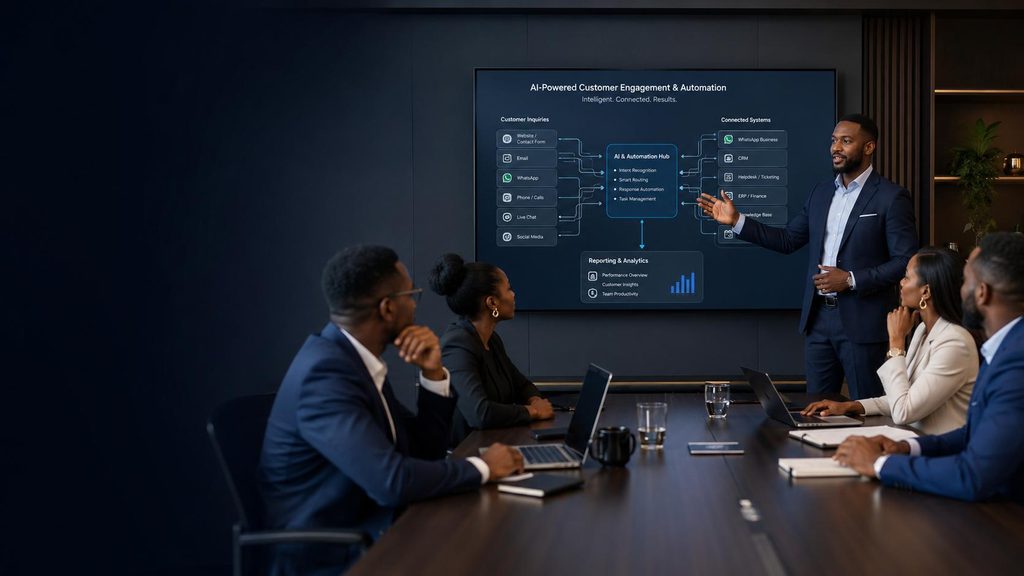
This is one of the opportunities with considerable potential for people who understand both technology and business operations.
Many small and medium-sized businesses still perform repetitive administrative tasks manually. AI and automation can help reduce this workload.
For instance, a business might need to:
- Automatically organise customer enquiries.
- Generate invoices and business reports.
- Sort incoming emails.
- Extract information from documents.
- Track customer requests.
- Prepare sales summaries.
- Connect different software applications.
AI automation professionals help businesses identify these problems and design workflows that address them.
Tools to explore: Make, Zapier, n8n, ChatGPT and Google Workspace integrations.
An individual could approach a Nigerian real estate company and offer to automate its customer enquiry process, organise leads and generate follow-up messages.
Rather than selling access to an AI tool, the consultant sells a solution to an existing business problem.
7. AI-powered education, tutoring and online courses

Education is another sector where AI is creating opportunities for individuals with specialised knowledge.
Teachers, trainers, researchers and professionals can use AI to develop educational materials, simplify difficult subjects, create practice exercises and organise online learning programmes.
Possible income opportunities include:
- Teaching people how to use AI tools.
- Developing online AI training programmes.
- Creating digital learning materials.
- Offering AI literacy workshops.
- Providing professional AI training to organisations.
- Developing educational content for schools.
- Offering specialised tutoring supported by AI.
For example, someone who understands AI tools could organise a practical training programme for Nigerian small business owners, showing them how to use AI for marketing, customer service and business administration.
The important requirement is to teach useful skills rather than simply demonstrate how to write prompts.
8. Data annotation and AI training services

Artificial intelligence systems require large amounts of data to learn how to recognise patterns, understand language and perform different tasks.
Data annotation involves labelling, organising, reviewing and categorising information that is used to train or evaluate AI systems.
Some examples include:
- Identifying objects in photographs.
- Transcribing audio recordings.
- Labelling video content.
- Reviewing AI-generated responses.
- Categorising text and documents.
- Translating and evaluating language datasets.
- Assessing whether AI answers are accurate and appropriate.
This area can offer opportunities for people with strong language, research and analytical skills.
It also presents an opportunity for Africans to contribute to AI systems that understand African languages and cultural contexts.
However, workers should carefully assess the reliability of platforms offering annotation work. Some projects are temporary, payment rates vary and work may not be consistently available.
9. Developing AI-powered software and applications

For people with programming knowledge, building AI-powered products could provide opportunities beyond traditional freelancing.
Instead of using AI only to complete tasks for clients, developers can create products that solve specific problems and generate recurring revenue.
Examples include:
- AI-powered educational applications.
- Customer service platforms.
- Agricultural advisory applications.
- AI-powered recruitment systems.
- Financial management assistants.
- Local-language translation applications.
- Business intelligence tools.
- Healthcare administration software.
Tools to explore: GitHub Copilot, Cursor, Replit, OpenAI APIs and Google AI development tools.
Consider an entrepreneur who develops an AI-powered agricultural advisory application that helps farmers access information about crop diseases, weather conditions and farming practices.
The application could generate revenue through subscriptions, institutional partnerships or business-to-business services, provided it delivers reliable value.
The biggest opportunity is not necessarily building another general-purpose chatbot. It is developing solutions that address problems African consumers and businesses actually experience.
10. AI consulting for small and medium-sized businesses

As businesses become increasingly interested in artificial intelligence, many owners do not know which tools to adopt, how much they should spend or how AI can improve their operations.
This creates an opportunity for AI consultants who can help organisations understand and implement the technology.
Services could include:
- AI readiness assessments.
- Identifying business processes suitable for automation.
- Recommending appropriate AI tools.
- Staff training and capacity building.
- Developing AI adoption strategies.
- Establishing responsible AI usage policies.
- Evaluating the performance of AI solutions.
An individual does not necessarily need to develop AI models to become a consultant. However, they must understand the technology, its limitations, business processes and the risks associated with adoption.
The most valuable consultants are those who can demonstrate measurable improvements in business operations.
What does the market say about AI-related earning opportunities?
The growing demand for AI skills is reflected in international freelance market research.
According to Upwork’s 2026 In-Demand Skills report, demand for the top AI-related skills on its marketplace increased by 109% year over year.
The report identified particularly strong growth in:
- AI video generation and editing: 329%.
- AI integration: 178%.
- AI data annotation and labelling: 154%.
- AI image generation and editing: 95%.
- AI chatbot development: 71%.
These figures reflect growth in demand on Upwork’s marketplace, not the entire global labour market. Nevertheless, they provide an indication of the types of services businesses are increasingly purchasing. Upwork
A separate 2026 Upwork study found that freelancers incorporating AI into their work earned 34% more per hour on average than those who did not. It also found that more complex AI-assisted professional services were gaining value, while some lower-complexity AI production work faced declining earnings. Upwork
The lesson is important: simply knowing how to generate AI content may not be enough. People who combine AI with professional expertise, problem-solving and the ability to deliver business results may have a stronger competitive advantage.
Which AI skills should Africans learn first?
Not everyone needs to become an AI engineer. The best starting point depends on an individual’s interests, educational background, available resources and the type of work they want to pursue.
Here is a practical breakdown:
| If you are interested in… | Skills to learn |
|---|---|
| Writing and journalism | AI research, content writing, fact-checking |
| Design and creativity | AI image generation, graphic design |
| Video production | AI video generation, editing |
| Business | AI automation, business consulting |
| Programming | AI development, API integration |
| Education | AI tutoring, instructional design |
| Languages | Transcription, translation, data annotation |
| Marketing | AI marketing, SEO, social media strategy |
| Administration | AI virtual assistance, workflow automation |
Where can Africans learn these skills for free?
There are several learning resources worth exploring.
Google AI learning resources
Introductory learning materials on generative AI, AI productivity and practical applications.
Explore Google’s AI learning resources
Microsoft Learn
Free technical learning paths covering AI fundamentals, Azure AI and related technologies.
DeepLearning.AI
Courses and educational resources covering generative AI, machine learning and AI development. Some courses are free to access.
Elements of AI
An accessible introduction to artificial intelligence, including its capabilities, limitations and applications.
Take the Elements of AI course
IBM SkillsBuild
Free learning resources covering AI, digital skills, data and professional development.
ALX Africa
Technology and professional development programmes for African learners. Check current programme availability and eligibility.
How can someone get started with making money using AI?
Learning about AI is important, but learning alone does not automatically generate income. People must turn their knowledge into services or products that customers need.
Here is a practical approach for someone starting with limited resources.
A 30-day roadmap to starting an AI-powered income stream
- Week 1: Choose one skill Select one area such as AI content writing, graphic design, video editing, chatbot development or automation. Avoid trying to learn every AI tool simultaneously.
- Week 2: Learn and practise Use free learning resources and practise with real-world examples. Understand how the tools work and where their limitations lie.
- Week 3: Build a portfolio Create three to five sample projects demonstrating what you can deliver. For example, a designer could create sample promotional flyers, while a writer could produce sample business articles.
- Week 4: Find your first customers Contact small businesses, startups, entrepreneurs and organisations. Share your portfolio, explain the problem you can solve and offer a clearly defined service.
For Africans, the customer base does not have to be limited to their home countries. A skilled professional in Nigeria, Ghana, Kenya or Uganda can potentially serve clients across Africa and internationally through remote work.
The challenges Africans must understand
Although AI presents significant economic opportunities, there are important challenges that could prevent many Africans from benefiting.
1. Limited access to reliable electricity and internet
In several African countries, unstable electricity, expensive internet access and limited digital infrastructure make it difficult for people to participate consistently in the digital economy.
2. Lack of practical AI skills
Many people are familiar with popular AI tools but lack the expertise to apply them professionally. Understanding how to write prompts is useful, but businesses need people who can deliver complete solutions.
3. Competition in the global marketplace
AI has lowered some barriers to entry into digital services. However, it has also made certain services easier to produce, increasing competition. Freelancers must distinguish themselves through quality, specialisation and professional experience.
4. Payment and international access challenges
Freelancers in some African countries face difficulties accessing international payment services, withdrawing earnings and complying with platform requirements. It is important to understand payment availability, fees, exchange rates and local tax obligations before accepting international projects.
5. Misinformation and unreliable AI outputs
AI systems can generate inaccurate information, fabricated references and misleading content. Professionals must verify their outputs, respect copyright and protect client information.
6. The risk of becoming dependent on foreign AI platforms
Most popular AI tools are developed and controlled by companies outside Africa. Their pricing, availability and terms of service can change. Africans should therefore develop transferable skills and support locally developed AI products rather than relying entirely on a single platform.
The International Labour Organization, in its November 2026 policy brief on AI and developing economies, highlights the importance of infrastructure, skills, worker protection and inclusive access to ensure that AI creates decent economic opportunities rather than widening existing inequalities.
Africa’s bigger opportunity: Building businesses with AI, not just using AI tools

Perhaps the biggest opportunity is not simply for Africans to use AI to earn money as freelancers. It is for African entrepreneurs to develop products and businesses that solve problems within their own communities and across the continent.
Africa has unique challenges that require locally relevant solutions.
For instance, an entrepreneur could develop an AI-powered application that helps smallholder farmers identify crop diseases. Another could build a local-language educational assistant for students who struggle with English-language learning materials.
There are also opportunities in healthcare administration, financial inclusion, logistics, transportation, retail and public service delivery.
The World Bank argues that Africa’s immediate opportunity lies in adopting and adapting practical AI solutions while investing in the infrastructure, skills, data and institutions required to support adoption.
This is an important distinction. Africa does not have to compete with Silicon Valley by building another version of every existing AI product. It can create value by developing technologies that understand African markets, languages, industries and everyday realities.
Conclusion: AI is an economic opportunity Africans cannot afford to ignore
Artificial intelligence is changing the global economy, and Africa has an opportunity to participate in this transformation.
For young Africans, the technology offers new ways to acquire skills, access international markets, start businesses and develop solutions to local problems. For entrepreneurs, it provides tools to improve productivity, reduce operational costs and reach new customers. For businesses, it offers opportunities to become more competitive.
However, the benefits will not come automatically. Access to technology must be accompanied by education, practical skills, reliable infrastructure, investment and supportive policies.
Africans must move beyond simply experimenting with AI tools and begin understanding how to apply them to real economic activities.
The future will not belong exclusively to people who know how to use artificial intelligence. It will increasingly favour those who can combine AI with creativity, professional expertise, innovation and problem-solving.
The real opportunity is not just to use AI. It is to build something valuable with it.