Seoul/Cairo – Africa’s artificial intelligence ambitions gained new institutional and infrastructural backing this month, as the African Development Bank (AfDB) formalized a partnership with South Korea to establish a Korea-Africa AI Hub, while private-sector infrastructure investment from Cassava Technologies, NVIDIA and Vodafone Egypt continued to expand the continent’s compute capacity.
A New Hub, Anchored in Seoul
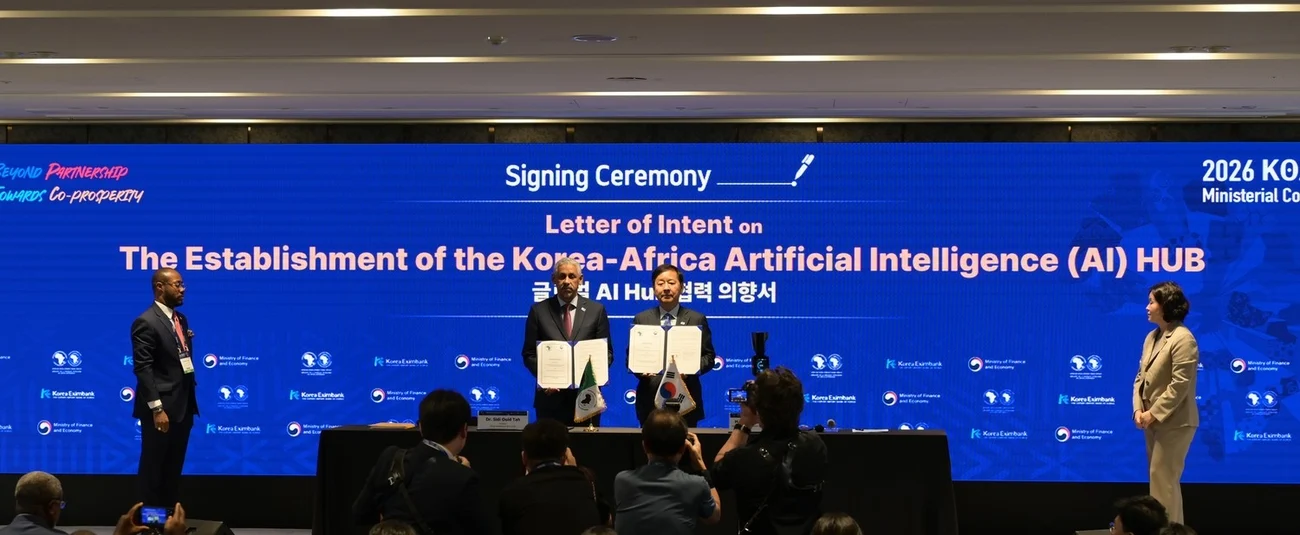
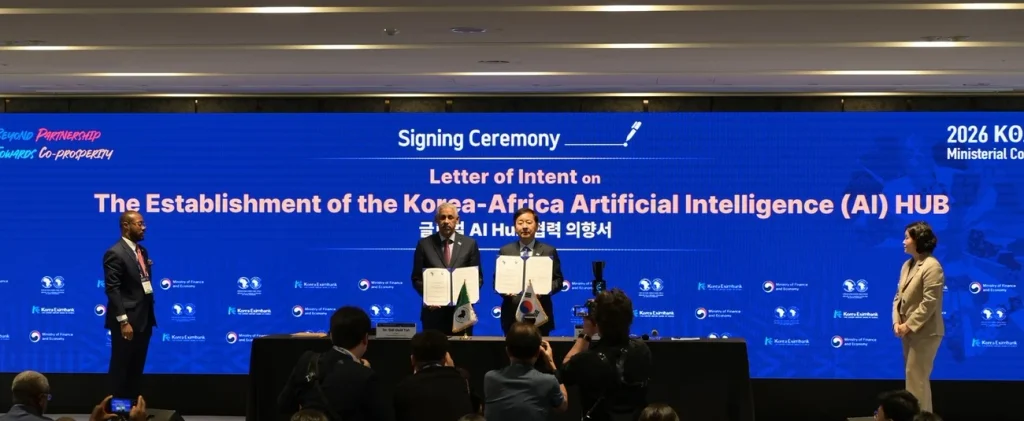
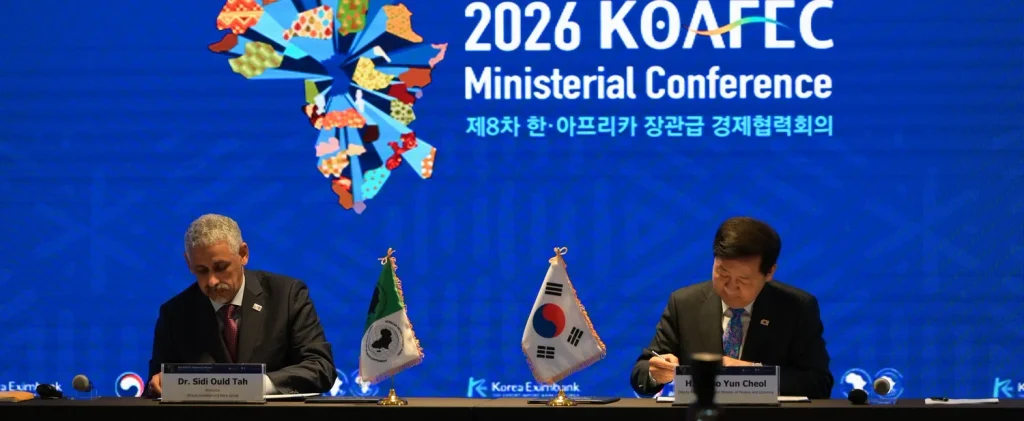
On September 9, 2026, AfDB Group President Dr. Sidi Ould Tah and South Korean Deputy Prime Minister and Minister of Finance and Economy Koo Yun-cheol signed a Letter of Intent (LOI) in Seoul to establish the Korea-Africa AI Hub. The agreement was signed on the sidelines of the eighth Korea-Africa Economic Cooperation (KOAFEC) Ministerial Conference, held under the theme “Harnessing AI and Digital Infrastructure for Africa’s Transformation.”
The Hub, expected to be based in Korea, is designed as a long-term platform bringing together governments, financial institutions, research centers, universities and businesses to support the responsible development, adoption and financing of AI technologies across Africa. It builds on two decades of cooperation under the KOAFEC framework, through which Korea’s cumulative contributions have reached $132.82 million as of May 31, 2026 – making it the AfDB’s largest active bilateral trust fund. Of that total, roughly $50 million has financed technical assistance and project preparation, underpinning more than 40 investment operations worth over $6 billion, and Korean funds have helped mobilize at least $4 billion in additional financing.
The AfDB continues to frame the initiative against a well-worn projection: that effective AI adoption could add up to $1 trillion to Africa’s GDP by 2035, contingent on progress in infrastructure, digital skills, data systems and governance. Bank President Ould Tah underscored the scale of the challenge at the conference, noting that AI “does not develop based on aspirations alone” a pointed reminder that Africa currently accounts for less than 2% of global data-center capacity.
A Second, Narrower Agreement
Distinct from the headline Hub LOI, the AfDB also signed a separate three-year Letter of Intent with South Korea’s National Information Society Agency (NIA), inked by Ousmane Fall, the Bank’s Director of Industry and Trade Development, and Yoon-Seok Ko, the NIA’s Vice-President. This agreement is more narrowly scoped, targeting cooperation on data governance, the creation of AI-ready datasets, and digital public infrastructure (DPI) with NIA contributing technical expertise drawn from digital-policy work across roughly 137 countries, while the AfDB identifies country priorities and mobilizes financing, including through the KOAFEC Trust Fund.
The DPI component is widely seen as the most strategically significant element of the arrangement, echoing a similar push last month when Morocco and India agreed to a joint commission built around India’s Aadhaar, UPI and DigiLocker stack government-owned, interoperable digital rails rather than proprietary platforms.
Korea’s broader KOAFEC push also included a separate letter of intent between the AfDB and the Korea Advanced Institute of Science and Technology (KAIST) to strengthen African capacity in AI research and knowledge transfer, and a new five-year memorandum of understanding between the AfDB and Korea’s Export-Import Bank to deepen co-financing across AI, infrastructure, energy, critical minerals and transport.
Cassava and NVIDIA Scale Up Compute
While the Seoul agreements addressed governance and financing architecture, private infrastructure investment continued to close Africa’s underlying compute gap. Cassava Technologies the pan-African technology group founded by Zimbabwean entrepreneur Strive Masiyiwa has been building out what it calls “AI factories” in partnership with NVIDIA since 2025, under a deal reported at roughly $700 million.
The rollout began with the delivery of 3,000 NVIDIA GPUs to a Cassava-built facility in South Africa, with plans to deploy a further 12,000 GPUs across Egypt, Nigeria, Kenya and Morocco over three to four years. NVIDIA has since taken an undisclosed equity stake directly in Cassava, deepening a relationship the companies describe as Africa’s first NVIDIA cloud partnership. Cassava has also signed a memorandum of understanding with the South African AI Association, giving more than 3,000 AI professionals direct access to GPU clusters.
Industry analysts have framed the deal as part of a broader geopolitical repositioning. Unlike China’s state-led Belt and Road and Digital Silk Road investments, the Cassava-NVIDIA partnership follows a private-sector model that aligns with what the White House has termed “commercial diplomacy” using private capital rather than state financing to extend US technological influence on the continent. The stakes are considerable: analysis from Zindi, a community of AI builders across 52 African countries, has found that only about 5% of the continent’s AI practitioners currently have access to the computational power needed for research and innovation.
Egypt Gets Its First National AI Factory
That infrastructure push reached a new milestone on September 8, 2026, when Vodafone Business and Cassava Technologies announced the launch of Egypt’s first national AI factory. The facility offers government entities and businesses GPU-as-a-Service (GPUaaS) on NVIDIA-powered infrastructure, with data hosted and processed entirely inside Egypt to meet local regulatory and data-residency requirements.
Mahmoud El-Khatib, Vice President of Enterprise Business at Vodafone Egypt, called the partnership “a pivotal step in Vodafone Egypt’s technology journey,” saying it would strengthen the country’s AI infrastructure capabilities while supporting “digital sovereignty” and attracting further investment in advanced technologies. The facility sits within Vodafone Egypt’s broader spending plans, which include more than EGP 20 billion ($300 million) in investment for the current fiscal year, building on more than EGP 125 billion ($2.45 billion) invested over 28 years in the Egyptian market.
The launch also comes as Egypt positions itself as a hub for multiple, rather than singular, infrastructure partnerships. Egypt’s Communications Minister Raafat Hindi said days before the announcement that the country was actively courting multiple global infrastructure partners rather than backing one national champion a posture consistent with Egypt’s standing as the top-ranked African country on the Government AI Readiness Index, even as its draft AI strategy flags dependence on US technology firms as a strategic risk.
The Common Thread: Power, Cost and Governance
Across both the Seoul agreements and the Cassava-NVIDIA-Vodafone infrastructure rollout, the same structural constraints recur. AI-optimized data centers demand far greater power density and cooling capacity than conventional facilities NVIDIA’s latest H100 and H200 GPUs can each draw up to 700 watts, with training clusters running thousands of them simultaneously. Reliable electricity, compute affordability and regulatory compliance remain the binding constraints on how quickly announcements like these translate into usable capacity for African researchers, startups and governments.
For now, the pattern is clear: multilateral institutions are building the financing and governance scaffolding, while private technology companies race to lay the physical compute underneath it. Whether the two tracks converge fast enough to meet the AfDB’s $1 trillion GDP projection by 2035 remains the open question shaping Africa’s AI trajectory through the rest of the decade.