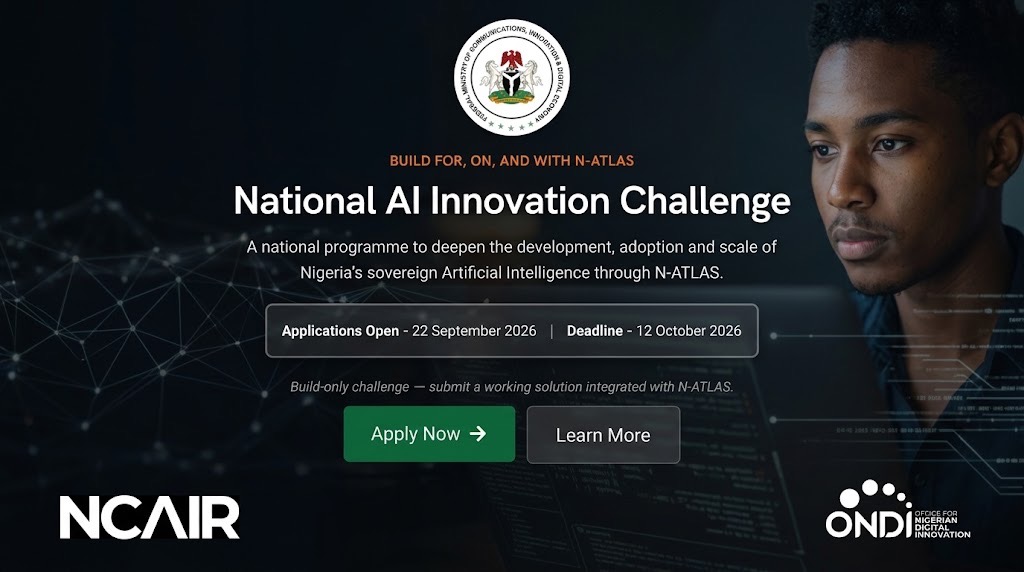
Applications are open for a new national build-only AI challenge aimed at developers, researchers, startups and technology innovators building practical solutions with Nigeria’s N-ATLAS multilingual AI model.
Nigeria has opened applications for the National AI Innovation Challenge (NAIC) 2026, a new programme designed to accelerate the development and practical adoption of N-ATLAS, the country’s open-source multilingual large language model.
The challenge, implemented by the National Centre for Artificial Intelligence and Robotics (NCAIR) and the Office for Nigerian Digital Innovation (ONDI) under the Federal Ministry of Communications, Innovation and Digital Economy, is positioning N-ATLAS as more than a model: the programme is seeking tools, applications and specialised AI systems that can be deployed and tested in real-world settings.
Applications opened on 22 September 2026, with submissions closing on 12 October 2026 at 11:59 PM West Africa Time (WAT).
A “build-only” AI challenge
One of the defining features of the programme is its emphasis on working technology.
The organisers state that every valid submission must include a functioning technical artefact integrated with N-ATLAS, alongside evidence of real-world validation.
That means concept notes, pitch decks, research papers or mock-ups without a working implementation are not sufficient.
Applicants are expected to demonstrate three core elements:
- A working software, model, dataset, API or other technical artefact.
- Genuine integration with N-ATLAS.
- Evidence of testing with real users, real data or live benchmarks.
The requirement is intended to move the conversation around sovereign AI from simply having access to a model toward building the infrastructure and applications needed to make that model useful at scale.
What is N-ATLAS?
N-ATLAS stands for Nigerian Atlas for Languages and AI at Scale.
According to the official challenge website, it is Nigeria’s first open-source, multilingual large language model. The model has been fine-tuned from Llama-3 8B and supports Yoruba, Hausa, Igbo and Nigerian-accented English.
It also includes Automatic Speech Recognition capabilities intended to support voice-driven applications.
The challenge therefore focuses on building around capabilities that are particularly relevant to Nigeria’s linguistic diversity and the country’s large population of users who may face barriers to conventional text-based digital services.
Three areas where applicants can build
Participants must select one of three problem statements.
1. Developer Infrastructure
The first category focuses on making N-ATLAS easier for other developers to use.
Possible projects include:
- Python or JavaScript SDKs.
- Browser-based playgrounds for experimenting with N-ATLAS.
- Fine-tuning starter kits.
- Evaluation and benchmarking tools.
- Developer documentation and working examples.
The requirement is that the solution must directly integrate with N-ATLAS rather than simply wrapping another general-purpose AI model.
2. Voice-First Access
The second category targets Nigerians who may not primarily interact with digital services through typing.
Applicants can build voice-first applications using N-ATLAS speech capabilities across channels such as:
- WhatsApp voice services.
- Interactive Voice Response (IVR).
- USSD-based services.
- Low-bandwidth mobile applications.
Potential applications include agricultural advisory services, education, primary health information, civic information and financial literacy.
For this category, the organisers specifically require voice input to use the official N-ATLAS Automatic Speech Recognition service for the relevant language.
3. Sectoral Fine-Tuning
The third category asks builders and researchers to adapt N-ATLAS to specific Nigerian sectors.
The challenge identifies areas including:
- Education and learning.
- Primary and community healthcare.
- Smallholder agriculture.
- Legal rights and civic literacy.
- Basic financial literacy.
Teams are expected to fine-tune N-ATLAS for a clearly defined domain, demonstrate measurable improvement against the base model and deploy the resulting model through a documented API that another developer can integrate.
Who can apply?
The challenge is open to Nigerian universities, research institutions, startups, technology companies, independent developers and innovation teams, subject to the requirements of the selected participation track.
The general requirements include:
- Team members must be Nigerian citizens or registered Nigerian entities.
- The submission must be original work that has not previously been awarded in another competition.
- A team can submit to only one problem statement.
- The submission must contain a functioning technical artefact integrated with N-ATLAS.
- Applications and supporting materials must be submitted in English.
The programme has two participation tracks: Academia & Research and Innovation & Enterprise.
The Academia & Research track is intended for university-based research teams, AI laboratories, postgraduate researchers and faculty, while Innovation & Enterprise is aimed at startups, technology companies, social enterprises, independent developers and innovation hubs.
Individual Innovation & Enterprise applicants must be Nigerian citizens aged 18 or older, while company applicants must meet the relevant Corporate Affairs Commission registration requirements. Diaspora teams can participate where at least 50% of the team is based in Nigeria.
What applicants must submit
The organisers have outlined seven core submission components:
- Working artefact — such as a repository, deployed application, published model, live API or dataset.
- N-ATLAS integration evidence — documentation showing how N-ATLAS is being used.
- Real-world validation — evidence from users, real data or benchmarks.
- Technical documentation — including architecture, setup and usage instructions.
- Video demonstration — a three-to-five-minute demonstration of the solution operating end-to-end.
- Team profile — including members, affiliations and roles.
- Endorsement or registration documentation — depending on the selected track.
The validation threshold also varies by problem statement.
Developer Infrastructure submissions require at least two external beta testers. Voice-First Access projects require a minimum of 50 documented real-user interactions, while Sectoral Fine-Tuning projects must provide a benchmark containing at least 500 examples comparing the adapted model with base N-ATLAS.
How submissions will be assessed
The evaluation framework places significant emphasis on the quality of the actual build and its relationship with N-ATLAS.
The stated criteria include:
- Working artefact and technical rigour.
- Depth and correctness of N-ATLAS integration.
- Real-world validation.
- Potential social, economic or ecosystem impact.
- Scalability and sustainability.
- Team capability.
This makes the challenge distinct from competitions where a strong presentation or business concept can compensate for limited technical implementation.
Here, the technology itself is central to the submission.
What selected teams can receive
The programme says all applicants will have access to technical support, including technical clinics, office hours, N-ATLAS onboarding resources, reference materials, university roadshows and ecosystem briefings.
Shortlisted teams may receive:
- N-ATLAS API credentials.
- Compute credits through partner infrastructure.
- Technical mentorship.
- Support to strengthen and harden their builds.
- Invitations to the Nigeria AI Innovators Summit.
- Inclusion in the NITDA AI talent registry.
- Priority consideration for government AI pilots.
Additional opportunities are available to winners depending on their track, including NCAIR research-lab partnerships, publication and model-card support, ONDI incubation support, investor introductions and potential government procurement pathway review.
Key dates
The current programme timeline is:
| Stage | Date |
|---|---|
| Applications open | 22 September 2026 |
| Build and submission period | 22 September – 12 October 2026 |
| Application deadline | 12 October 2026, 11:59 PM WAT |
| N-ATLAS integration check | 15 – 17 October 2026 |
| Shortlisting notification | 16 – 20 October 2026 |
| Mentorship phase | 25 October – 4 November 2026 |
| Digital Nigeria Showcase | 8 – 10 November 2026 |
The organisers state that late submissions will not be accepted.
Why the challenge matters for Nigeria’s AI ecosystem
The significance of the programme extends beyond the competition itself.
Nigeria already has a growing community of developers, startups, researchers and technology companies experimenting with generative AI. The N-ATLAS challenge is attempting to direct some of that technical capacity toward a locally developed model and toward applications reflecting Nigerian languages, users and operating environments.
Its three-track structure also addresses different layers of an AI ecosystem.
Developer infrastructure can make a model easier for other engineers to adopt. Voice-first applications can extend AI access to users who face literacy, language, connectivity or interface barriers. Sectoral fine-tuning can turn a general-purpose model into a more specialised tool for specific Nigerian contexts.
The programme’s insistence on working products and measurable validation also puts practical deployment at the centre of the exercise.
For developers and startups considering participation, the immediate question is therefore not simply “What AI idea can we pitch?” but “What can we actually build, integrate with N-ATLAS and validate before the deadline?”
How to apply
Applications and the full eligibility, submission and evaluation requirements are available through the official National AI Innovation Challenge website.
Official National AI Innovation Challenge — Build with N-ATLAS
With the deadline set for 12 October 2026, applicants have a limited build window to move from an idea to a functioning, tested N-ATLAS-powered solution.
For Nigeria’s AI community, the challenge represents a push toward building with local AI infrastructure—not simply talking about it.